
In industrial manufacturing, choosing the right material is a strategic decision that impacts everything from performance and durability to reliability and operational consistency. Two of the most common materials in the polymer world are acrylic resins and epoxy resins. At first glance, they may seem similar, but their chemical compositions, curing mechanisms, and physical properties differ significantly.
Acrylic resin is a group of related thermoplastic or thermosetting plastic substances derived from acrylic acid, methacrylic acid, or other related compounds.
Epoxy resin is a type of thermosetting material that can be a two-part clear liquid consisting of a resin and a hardener.
Both materials have their place in industrial applications. However, when durability, chemical resistance, structural strength, and environmental considerations are critical, epoxy systems often provide big advantages. Understanding these differences can help you select the right resin for your application.
As a leading supplier of epoxy resins and polyurethane, Copps Industries offers more than 500 products to customers across 27 countries.
The Difference Between Acrylic and Epoxy Resin
Acrylic resin (thermoset version) is formed by free-radical polymerization. When exposed to a catalyst, heat, or UV light, the monomers link together to form long polymer chains.
What is acrylic resin?
Acrylics (thermoset) are strong, durable, and UV-resistant, making them ideal for a variety of applications, including outdoor use.
Key characteristics of acrylic resin
The combination of clarity and fast curing times makes acrylic resins a natural choice for applications where speed is a priority over strength and resistance.
- Optical Clarity: Often used as a substitute for glass due to high light transmission and resistance to yellowing.
- Fast Curing: Can reach full strength quickly, offering an advantage on high-speed assembly lines.
What is epoxy resin?
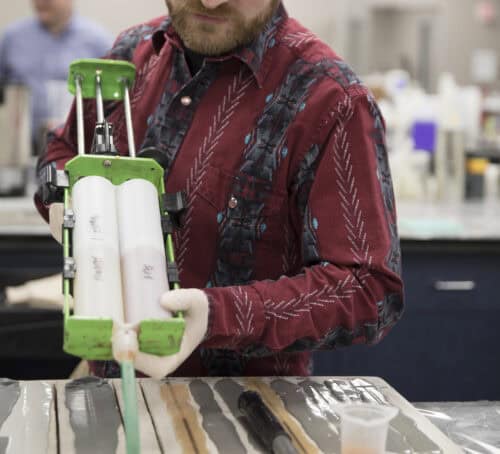
Epoxy resin is a thermosetting material used to produce hard, durable castings, coatings, and adhesives. It comes in a liquid form that cures quickly and adheres to various substrates, including glass, wood, stone, concrete, and metal. The liquid epoxy is combined with a chemical hardener, which cures it into hardened plastic. Once the mixture is set, it cannot be remolded or reshaped.
Key characteristics of epoxy resin
The unique combination of strength, chemical resistance, and thermal stability makes epoxy an ideal choice for a wide range of industrial applications.
- Mechanical Strength: Known for high tensile, compressive, and flexural strength.
- Chemical Resistance: Highly resistant to moisture, solvents, acids, and bases once cured.
- Low Shrinkage: Low shrinkage during curing, which ensures dimensional stability in precision components.
- Thermal Stability: Withstands high operating temperatures, sometimes exceeding 400°F (204°C) in custom formulations.
Common Applications of Acrylic and Epoxy Resin
These performance characteristics directly influence where each material is most commonly used. While acrylic resins are often selected for applications that prioritize speed and optical clarity, epoxy systems are frequently chosen for applications that require strength, durability, and long-term reliability.
Applications for acrylic resin
Acrylic resins are commonly used in applications where fast curing, weather resistance, and optical clarity are important. Typical uses include:
- Electronics Assembly: Sealing connectors, coating circuit boards, and supporting high-speed production environments.
- Automotive Components: Bonding exterior trim and plastic parts (such as brake lights) exposed to weather and vibration.
- Consumer Products: Phone screens, displays, and other applications requiring clarity and resistance to shattering.
- Medical and Dental Devices: Dentures and other molded components that benefit from acrylic’s durability and appearance.
Applications for epoxy resin
Epoxy resins are often selected in demanding, high-stress industrial environments where strength, adhesion, chemical resistance, and durability are critical. Common applications include:
- Structural Bonding and Composites: Aerospace structures, fiberglass components, and other applications where high strength-to-weight ratios are critical.
- Electrical and Electronic Components: Potting, encapsulation, and insulation of motors, transformers, and heat-sensitive electronics.
- Industrial Coatings and Infrastructure: Protective linings and coatings, industrial flooring, concrete repair, and anchoring systems common in civil engineering.
- Manufacturing and Maintenance: Adhesives, tooling, equipment repair, and other applications requiring strong bonds and long-term reliability.
Beyond industrial applications, epoxy resin is also widely used in decorative castings, artistic projects, and specialty coatings because of its versatility and durability. It can be cast into shapes, molded into three-dimensional designs, or used as a protective coating for a variety of projects.
How to Choose the Right Material for Your Application: Acrylic vs. Epoxy Resin
Selecting the right resin is essential to the success of your project, but it involves more than comparing technical specs. To choose the right material for your needs, consider how a material will perform throughout the entire application lifecycle, from processing and installation to long-term use and maintenance.
Consider the Application Requirements
If speed is your primary concern, acrylic systems may offer an advantage. Many acrylic formulations cure rapidly, making them useful in high-throughput manufacturing environments.
However, applications requiring structural strength, chemical resistance, or long-term durability often benefit from epoxy systems. Epoxies offer significant formulation flexibility, which means they can be engineered for a wide range of environmental and operational conditions.
The substrate itself can also influence material selection. Epoxy systems are commonly used on materials such as wood, concrete, fiberglass, and metal because of their exceptional adhesion and ability to create durable, lasting bonds. Acrylic systems can also bond to a variety of substrates and are often used when rapid curing is a higher priority than long-term structural performance.
Consider Processing Conditions
Viscosity, working time, and application thickness can all influence material selection.
Epoxy systems generally offer longer working or open times, allowing you to mix, position, and apply materials with greater flexibility. They can also be formulated for applications ranging from thin coatings to deep-pour encapsulation and potting compounds.
Acrylic systems typically cure faster but may be more limited in thick-section applications due to heat generation during curing.
Flow characteristics are another important consideration. Both acrylic and epoxy systems are available in a range of viscosities, from low-viscosity liquids to non-slump gels.
Consider Environmental and Safety Factors
It’s also smart to take into account workplace and environmental factors when selecting a resin.
Certain acrylic formulations that utilize methyl methacrylate (MMA) chemistries may require additional ventilation, storage, transportation, and handling precautions due to their odor, flammability, and volatile organic compound (VOC) characteristics.
Epoxy systems can provide a high-performance alternative that aligns with many manufacturers’ environmental and workplace objectives.
Acrylic vs. Epoxy: At a Glance
This table offers a high-level comparison of the factors manufacturers often consider when selecting between acrylic and epoxy resin systems.
| Feature | Acrylic Resin | Epoxy Resin |
| Typical Use | Fast-paced production, optical applications | Industrial, structural, and high-performance applications |
| Cure Time | Fast (seconds to minutes) | Slow to Moderate (hours) |
| Bond Strength | High (impact resistant) | Highest (structural and rigid) |
| Surface Prep | Minimal | Minimal |
| Chemical Resistance | Moderate | Excellent |
| Safety and Environmental Considerations | May require additional ventilation, storage, and handling precautions | Often supports broader environmental, workplace, and operational goals |
Copps Industries: Helping You Choose the Right Resin for Long-Term Success
Acrylic and epoxy resins each offer distinct advantages, and the right choice depends on the requirements of the application. Factors like cure speed, environmental conditions, durability requirements, chemical exposure, and processing constraints should all be considered in material selection.
For many industrial applications, epoxy systems provide the combination of strength, versatility, chemical resistance, and reliability that supports consistent performance over time.
As a leading supplier of epoxy resins and composite materials, Copps Industries works closely with customers to develop solutions tailored to your unique operating environments. With more than 500 epoxy products and decades of formulation expertise, we can help you choose materials that deliver performance not just in the lab, but in the real world.
Connect with us today to learn more about our products and services.